
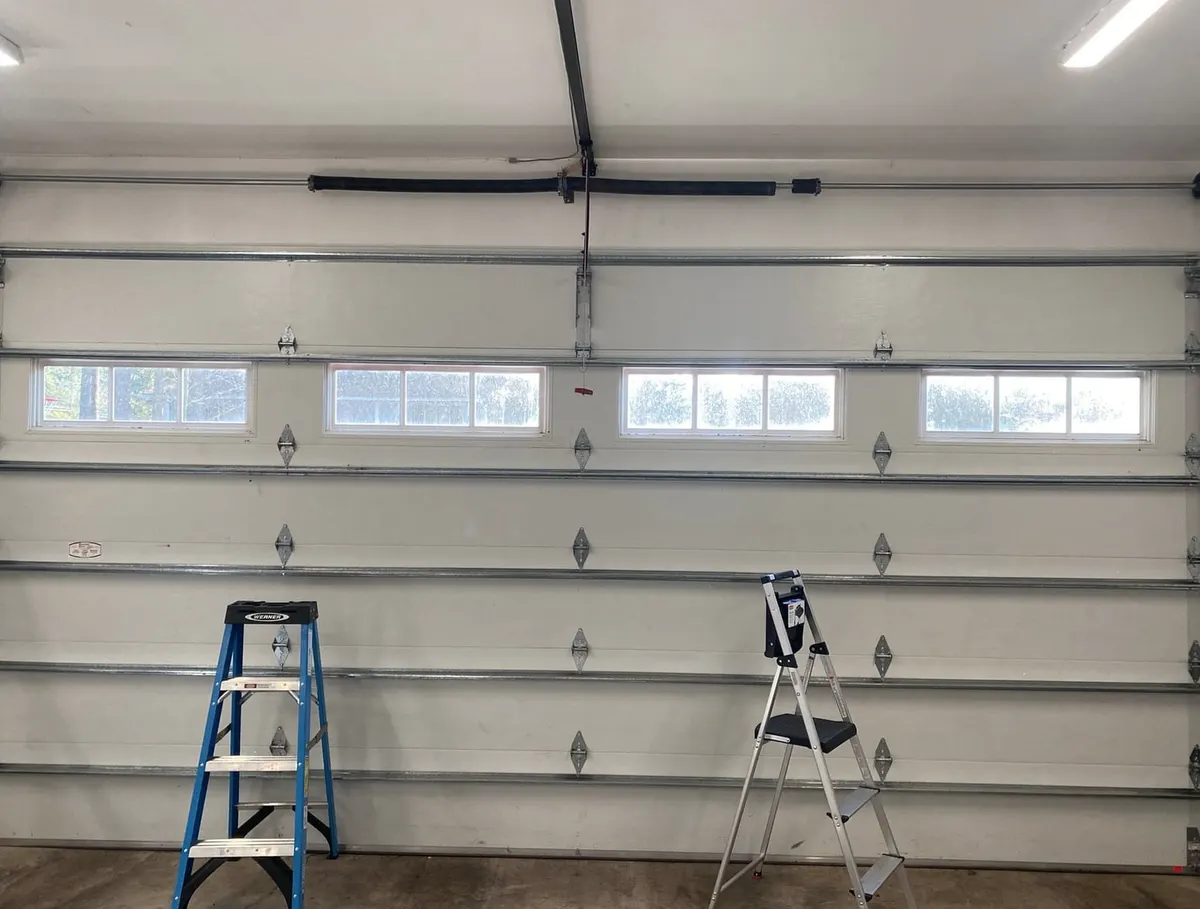
What the Technician Sees First
Most calls about a loud, jerky, or grinding garage door start the same way: the homeowner is sure it's the opener motor or a dying spring. The technician walks in, raises the door by hand, and within ten seconds is looking at the cables and rollers instead. One cable has a few strands sticking out like a frayed shoelace. The rollers are chipped, flat on one side, or rattling loose in the track. Nobody argued about those parts because nobody thought to look at them — all the attention goes to the big, expensive-sounding stuff.
This is worth settling plainly, because it's a common household disagreement: one person wants to call someone now, the other wants to wait until something actually breaks. With cables and rollers, waiting for an obvious break is the wrong bet.
Cables: Small Wire, Big Job
The cables run from the bottom corners of the door up to the drum near the spring system. Their whole job is to transfer the spring's lifting force evenly to both sides of the door. They're thin, they're under constant tension, and they take abuse every single time the door moves.
What makes a cable fray:
- Repeated flexing around the drum and pulleys, which wears the outer strands first
- Rust from moisture exposure — a real issue after a wet winter, and worse near the coast where salt air accelerates corrosion on galvanized wire
- Misalignment, where the cable rubs against the drum edge or track instead of winding smoothly
- Age — most cables are rated for a set number of cycles, and a well-used door gets there faster than people expect
A frayed cable rarely fails cleanly. It usually lets go under load, which means the door drops unevenly, one corner lower than the other, sometimes with a loud bang. Because the cable is connected to a spring system storing serious tension, this is not a part to inspect or replace yourself. If you see frayed strands, treat it as a same-week problem, not a someday problem.
Rollers: The Part Everyone Ignores
Rollers are the wheels that ride inside the track and let the door glide instead of scrape. They're cheap, they're small, and they fail slowly — which is exactly why they get ignored until the noise is unbearable.
Signs a roller is done:
- Grinding or popping sound at a specific point in the door's travel, not the whole cycle
- Visible wear flat spot or cracking on the roller wheel itself
- The door shuddering or jerking as it passes a certain section of track
- A roller that's visibly loose, tilted, or missing from its bracket entirely
Plastic rollers wear out faster in homes with heavy daily use or dusty garages — common during San Diego's dry season, when grit works its way into the track and track hardware. Nylon rollers last longer and run quieter, and they're a reasonable upgrade if the current ones are the builder-grade plastic kind. Steel rollers are durable but louder and harsher on the track long-term.
The good news: worn rollers are low-risk to replace and inexpensive compared to almost everything else on a garage door system. The bad news: a worn roller left in place long enough will eventually damage the track it's riding in, turning a small fix into a bigger one.
Why These Two Get Blamed on Something Else
Cables and rollers don't announce themselves the way a dead opener or a snapped spring does. There's no total failure moment — just a gradual decline in smoothness, a new rattle, a slightly uneven lift. Homeowners hear noise and assume opener trouble. They see the door sag and assume the spring is going. Often both guesses are half right: a worn roller can make a fine opener work harder than it should, and a fraying cable puts uneven strain on an otherwise healthy spring. Fixing the actual worn part is usually the cheaper, faster answer than replacing the component getting blamed.
Houses with older, unreinforced garage openings — including some retrofitted for earthquake bracing — can also see uneven track wear as the opening settles slightly over time, which accelerates roller wear on one side faster than the other. If one side of your door sounds different from the other, that's a clue worth mentioning to whoever inspects it.
When to Call San Diego Garage Door Service
If you can see frayed cable strands, hear a grinding sound localized to one spot in the track, or notice the door isn't lifting level on both sides, it's time to call. San Diego Garage Door Service handles cable inspection and spring replacement together, since the two systems work as a pair and shouldn't be serviced in isolation. For roller wear, a garage door maintenance visit covers roller replacement, track alignment, and a lubrication pass that cuts down on dust buildup — useful heading into the dry months when grit is at its worst. Either visit also catches small issues before they turn into a dropped door or a damaged track.
If your door in San Diego, La Jolla, Chula Vista, El Cajon, National City, Coronado, Encinitas, or Poway has started sounding different than it used to, don't wait for the obvious break. Call San Diego Garage Door Service and get it looked at before the quiet wear turns into a loud, inconvenient failure.